" height="39.61165048543689px" id="ZNWWQDUsB" transform="translate(0 0.195)" width="39.79498837473122px"/><path d="M 14.36 13.33 C 15.643 13.33 16.374 11.864 15.601 10.841 L 7.888 0.619 C 7.048 -0.494 5.28 -0.022 5.107 1.362 L 4.627 5.196 C 4.496 6.248 4.009 7.224 3.248 7.963 L 0.475 10.653 C -0.526 11.624 0.161 13.32 1.555 13.321 Z" fill="rgb(255, 87, 199)" height="13.329661963960334px" id="BFIxPoook" transform="translate(3.344 8.474)" width="15.91740701520282px"/></svg>)

Cost belongs in conceptual design as an input the designer uses, and as a number the estimator can work with while the scheme is still cheap to change.
What is conceptual estimating — and what is it not?
Conceptual estimating is used to predict a project’s approximate construction cost in the early planning phase before detailed drawings. This number is good enough to choose between options. It is not detailed estimating, and it is not the bid.
Why does cost still arrive after the design?
Conceptual estimating is typically only done after a conceptual design is already complete. Details like program, system approach, parking, and envelope get decided. Those are already cost decisions, whether anyone prices them ahead of time.
So cost arrives after the design because the sequence of work. Design, send drawings, then price. Fees, liability, and the available tools are all reasons for this handoff separation. We unpack that sequence in constructible design.
That sequence cannot meet the speed owners ask for now. They want options and a number on a shorter cycle.
What does cost fluency look like in a designer’s hands?
Cost fluency is expertise to convert construction cost and design choices. In many projects, with a builder partner engaged later, it's up to the designer to apply their best judgement on costs. In a time where many designers feel the squeeze more than ever this is an obvious place to uplevel their client value embracing the real constructible considerations. Cost fluency is a competitive advantage to designers.
What do builders actually want from cost fluency?
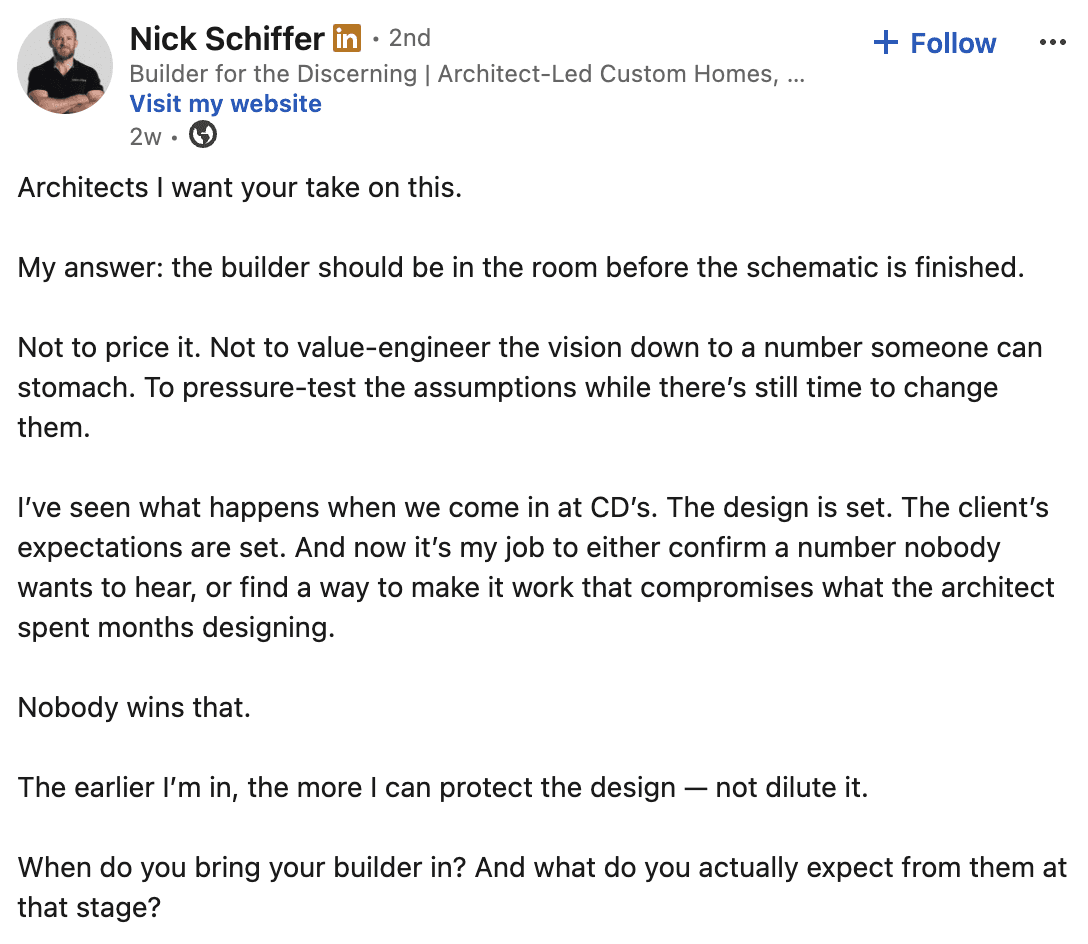
Builders want a shared early-stage estimating loop. They do not want to be the architect. They want the first drawing to already fit the budget, so they stop pricing schemes that were never going to work.
A preconstruction lead we spoke to put it well:
We are not trying to be an architect. We are not trying to take the creativity away.
If we can’t afford more than 5% curtain wall and your design is 20% curtain wall you should know that. You can be creative to get to 5% and I want to lean on your creativity there.
You may as well do that right upfront so we avoid value engineering down the road.
Does designing with cost make the designer less of a designer?
No. Unbuilt work is not a portfolio. The satisfying part of the job is a building in the world, and cost fluency is how the design survives contact with a budget. Cost fluency doesn’t threaten the craft of design it elevates it.
The designers we talk to like David Cincotta, Gorman & Company get this:
“Arcol is construction, architecture, and development all in one package, it gets everyone is on board from day one.”